
History
A 5 y.o. Standardbred trotter was referred for total body scintigraphy for a non identified problem probably affecting the hind limbs. The horse, despite a good curriculum with 4 wins in the last 5 races, was affected by an unusual pattern of clinical signs of discomfort or pain hard to localize. In particular, the horse showed severe discomfort in the hindlimbs, with difficulty maintaining support on both hind legs, constantly shifting its weight from one side to the other. These signs were accompanied by intense sweating, restlessness and expression of pain. The distal hind limb nerve blocks led to partial improvements but to overall inconclusive results. Therapies with anti-inflammatory and muscle relaxant drugs proved useless.
Scintigraphy and radiographic examination
At clinical examination, the horse showed no lameness when moved at trot both on a straight line and in circle. The total body scintigraphy showed a normal pattern in the front limbs, neck and vertebral column, including the pelvis. The most significant uptake was localized in the distal hind limbs, specifically in the lateral aspect of both proximal interphalangeal joints where a clear spot became visible (Fig. 1, 2). This findings were quite unusual, particularly for a young trotter.
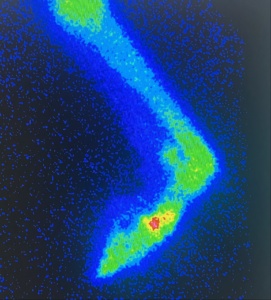 Fig. 1
 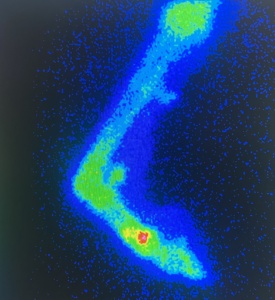 Fig. 2
The radiographic examination offered a clear explanation of the scintigraphic findings: both pastern joints showed remodeling with new bone formation of the distal lateral aspect of the proximal phalanx and degenerative changes in the articular rim, with fragmentation of the distal lateral articular border of the proximal phalanx on both sides (Fig. 3, 4 ).
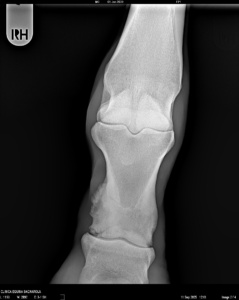 Fig. 3
 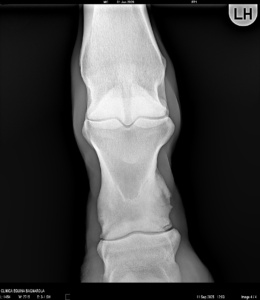 Fig. 4
Outcome
Due to satisfactory racing results despite the condition, the owner elected conservative treatment with local intra- and extra-articular therapies. In the following 5 months after the examination, the horse raced 10 times, with 5 wins and 3 places and improving its record time.
Concerning the etiology of the condition, the symmetry of the lesion can support an OCD more than a traumatic origin.